
Who needs an ICU air ambulance?
An ICU air ambulance is for a patient who needs intensive care during the flight itself, not only before and after it. That usually means someone who is ventilated, on several infusions to hold up their blood pressure, recovering from major surgery or trauma, or whose heart rhythm needs constant watching. Airlines will not carry these patients, and a standard air ambulance may not have the equipment, oxygen or staffing for a long sector.
The treating doctor's reports decide whether intensive care is needed. Our medical team reads them, talks with the treating team where needed, and recommends the lowest level of care that is clinically safe. Sometimes that is an ICU jet. Sometimes it is not, and we will tell you.
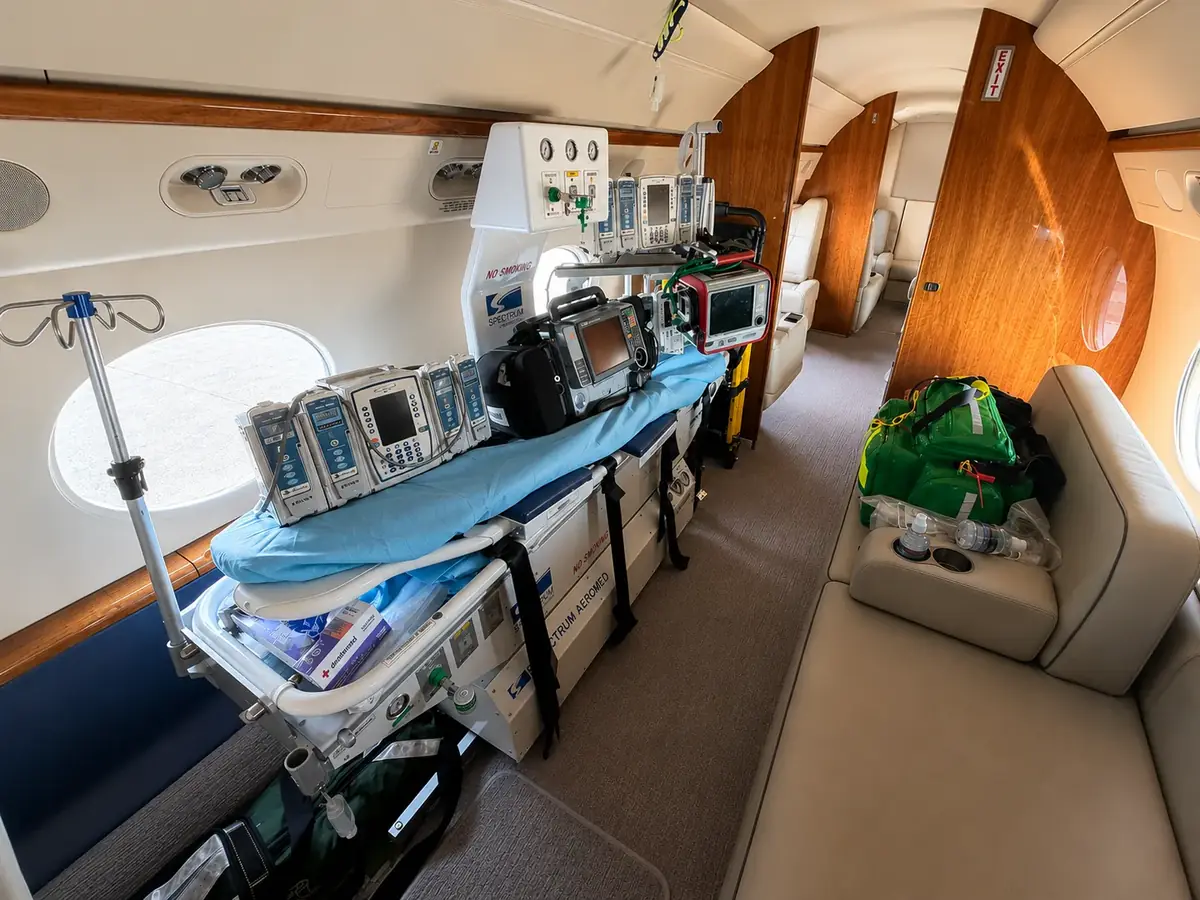
What is on board the aircraft?
The cabin is set up as a small intensive care bay: a transport ventilator, monitoring that includes invasive pressures, infusion pumps, suction, a defibrillator and enough oxygen for the whole sector plus a reserve. The team is usually an intensive care doctor and an ICU or flight nurse, with extra specialists when the case needs them. Drugs and blood products are planned in advance from the patient's current charts.
Can you move patients on ECMO or with cardiac support?
Yes, when the sending and receiving teams agree it is appropriate. An ECMO transfer needs a perfusionist or ECMO specialist, the circuit and console secured for flight, back-up power and a receiving centre that runs ECMO. Patients with ventricular assist devices, balloon pumps or recent cardiac surgery need similar planning. These are the most involved transfers we arrange, and they take longer to prepare than a ventilated patient.
How far can an ICU jet fly?
Long-range jets cover most Asia-Pacific sectors into Australia without stopping, and longer intercontinental transfers with one or more fuel stops. The medical plan covers the whole duration, including time on the ground. Departure depends on the patient being stable enough to move, the records, the permits and an accepting ICU bed. Once those are in place an aircraft can often be ready within [X] hours, but we give you a realistic timeline for your case rather than a promise.
What happens at each end?
An intensive care ambulance takes the patient from the ICU to the aircraft, with our team present for the handover at the bedside. On arrival a second ambulance meets the aircraft, and the team hands over to the receiving ICU in person with the flight record, imaging and reports. If the receiving hospital changes at short notice, or the patient's condition shifts on the day, the team agrees a revised plan with both hospitals before departure rather than after.